2013-04-09

Fedora 19 Alpha Testing: What you need to make sausage.

This blog is part of a series on installing Fedora 19 and testing its "parts".  This section will be prettified with links to the other parts if I get a chance.

Here are the ingredients to hardware testing a Fedora release in the Alpha and early Beta stages:

  1. Patience and being able to project patience. Release time is a frantic time for QA and developers, and people get cranky quickly. You will spend a lot of time waiting for answers or fixes, and you may need to explain the problem in detail multiple times, and multiple ways. [This usually happens with visual bugs where each person sees something slightly different due to fonts, monitors, graphics cards, etc.]
  2. You will need an email address that you can use to register to bugzilla and various mailing lists as needed. You can get an email address at mail.google.com, outlook.com, or mail.yahoo.com (or a dozen other ones.) The instructions for doing this is outside the scope of this tutorial.
  3. You will need a bugzilla.redhat.com account. If you do not have an account already, please go to https://bugzilla.redhat.com/createaccount.cgi to set up the account.
  4. You should have access to an irc client of some sort. Currently I am using the Linux version of xchat2 which came set up for the Freenode servers that Fedora and many other Free/Libre/Open Software groups use. I highly recommend registering a nick as outlined at http://www.wikihow.com/Register-a-User-Name-on-Freenode .
  5. You will need some sort of hardware to test with. I am going to use two different systems to start off with. The first system is an already installed Linux box to download and write the ISOs with. You can use Windows or MacOSX if you know what you are doing.. I don't so won't be.
    In choosing hardware you need to make sure you have reasonably  new hardware... I find that hardware over 5 years old is usually too old for day to day testing anymore. Not that the hardware may not be up to the task, but if you run into an issue that could be hardware related, it is probably never going to be fixed.For this round of testing I am going to be using an Asus A52F laptop from 2011. It contains
    • Pentium i5,
    • Intel graphics,
    • 4GB of memory,
    • and an EFI boot menu with its BIOS.
    I picked this laptop up on a clearance sale when the model was being replaced with a newer version. This allowed me to get it for under $400.00 which has allowed for various testing over the years.
  6. Backup media. I am going to be using a USB-2.0 500 GB USB drive, and will be backing up before I reinstall, and then restoring afterwords. I will document how to make backups with Fedora 19 when I get to that stage. 
  7. Some installation media. In the long ago past, I used CD-roms and DVD-roms for this exclusively, but for this release I am using a 16GB San Disk which was on sale. This was useful for testing the early test candidates which had a bug that made them larger than the 4GB that a DVD can hold. 
  8. You will need a test image. You can get these from a mirror of alt.fedoraproject.org (from http://mirrors.fedoraproject.org/publiclist/)
    lftp http://alt.fedoraproject.org/
    lftp alt.fedoraproject.org:/pub/alt> cd /pub/alt/stage
    lftp alt.fedoraproject.org:/pub/alt/stage> dir
    drwxr-xr-x  --  ..                   
    drwxr-xr-x            -  2013-03-21 04:15  19-Alpha-TC1
    drwxr-xr-x            -  2013-03-26 02:06  19-Alpha-TC2
    drwxr-xr-x            -  2013-03-29 04:08  19-Alpha-TC3
    drwxr-xr-x            -  2013-04-04 00:40  19-Alpha-TC4
    drwxr-xr-x            -  2013-04-05 03:41  19-Alpha-TC5
    drwxr-xr-x            -  2013-04-05 08:20  deltaisos
    drwxr-xr-x            -  2012-02-02 12:29  ec2
    drwxr-xr-x            -  2013-01-28 20:48  rawhide-20130128
    drwxr-xr-x            -  2013-03-01 18:45  rawhide-20130301
    lftp alt.fedoraproject.org:/pub/alt/stage> cd 19-Alpha-TC5/Fedora/x86_64/iso/
    lftp alt.fedoraproject.org:/pub/alt/stage/19-Alpha-TC5/Fedora/x86_64/iso> dir
    drwxr-xr-x  --  ..
    -rw-r--r--          260  2013-04-05 05:24  Fedora-19-Alpha-TC5-x86_64-CHECKSUM
    -rw-r--r--         4.7G  2013-04-05 05:23  Fedora-19-Alpha-TC5-x86_64-DVD.iso
    -rw-r--r--         312M  2013-04-05 05:15  Fedora-19-Alpha-TC5-x86_64-netinst.iso
    lftp alt.fedoraproject.org:/pub/alt/stage/19-Alpha-TC5/Fedora/x86_64/iso> mget Fedora-19-Alpha-TC5-x86_64-DVD.iso
    
  9. If the ISO is below 4.2 GB in size, you should be able to cut it to a DVD. In this case though the DVD install is larger than that so it will need to be cut directly to a USB key or booted via PXE or some other method. In this case we will be using a USB key. On the system you downloaded the ISO, we will use the dd command to write to the key.
    $ sudo -i 
    Password: @$@$#@$##@
    # lsusb # find out what the USB is
    # dd if=/dev/zero of=/dev/sdb bs=1024 count=100 # voudou. I do this because it is needed on some keys.
    # dd if=/home/smooge/Downloads/Fedora-19-Alpha-TC5-x86_64-DVD.iso of=/dev/sdb bs=1024
    
    On a USB-2 key, you are going to have a peak write of 15MB/s.. more likely 4 to 8MB/s since the bus is shared between USB devices. Be prepared to wait 5 to 10 minutes for it to finish writing. In a different terminal read the dd man page so you can see how to "track" how much is written if you want.

Fedora 19 Alpha Testing. Welcome to the Sausage Grinder.

Fedora 19 is working through its build cycles with a release scheduled for early Summer of 2014. The current stage of testing is "Pre-Alpha" where QA and Release Engineering are working on getting a release for alpha testing. While Alpha is known to be the most rabid of candidates, it is also the most critical to test on the theory that the sooner bugs are located, the sooner they may be fixed (or worked around).

In order to help this out, I am going to sacrifice my laptop for the cause and put it through various installs as they are released. I am also going to try and log everything so that future readers can follow along if you want to.  

WARNING: Due to the nature of the test candidate releases I am using for these first blogs.. expect a lot of crashes and missing features. Also because these are throw away releases, I am going to use old school testing methods.. pictures of screens are taken by hand camera and will have all kinds of crappy artefacts in them. My wording also won't be Documentation Level standards.. but more like my usual crappy English.

In the end, I hope these turn out to be useful anyway.

2013-01-19

FUDcon Day 2

So Saturday was Hackfest day where various people got together in teams and worked on what they liked. Some people worked on ARM hardware, others on cloud software, and others on HAM tests... and those were only the ones I could stumble past.

Earlier in the week I had slipped and fallen on the ice we had in Albuquerque, and my back finally seemed to decide it was the day to truly protest it. So I was not able to see most of the Hackfests, but I have heard that a lot of progress was done in many areas.

For me, I took a seat in the Infrastructure room, and began to pull in mirrormanager and how it works. While it will be a multi-month odyssey for me to get to the heart of this software, Matt Domsch was able to walk me through getting a patch made to log which set of mirrors was chosen first as the best possible mirror. Once this is deployed it should allow for us to get some statistics on whether clients are told local, ASN local, national, continental, or just random pick are the ones various ip spaces are getting the most. Hopefully it will allow us also to see when something comes up wrong or if we can improve spaces with mirrors.

At the end of the day, while everyone else headed towards the celebratory FUDpub experience and bowling.. my back decided it was time for me to retire for the night. So I layed down for a bit while the Vitamin I(brupofen) kicked in and then caught up on my posts for the last couple of days.

Thanks for reading. I am off to sleep.

FUDcon day 1

So day one of FUDcon was great this year. I woke up on time and got to the state of Fedora talk which I had missed by sleeping through the wakeup call, the phone alert, and my Dad telling me to get up (which he later remarked was just like my teenage years all over.)

We took the Redy2Party buses from the hotel to near Eaton Hall. As Robyn would remark later, we would eat in Eaton Hall and learn in Learned Hall. [You can't pay enough money for these puns people.] After the state of Fedora, we voted on the BarCamp talks we would want to listen to for the rest of the day. Sadly I continued a long running trend of every talk I voted for didn't make it to the list of final talks. Next year I expect people to pay me for what talks they want me to stay away from so that they have a better chance of making the schedule.

The talks in the morning were very good and I learned a lot about some new ARM server hardware from CalXeda.. which is good because we will be deploying a large number of the servers in our PHX2 facility later this month. Had a good lunch back at Eaton and listened to a series of lightening talks on upcoming features and software we might look forward to. After lunch I sat in on the EPEL discussion which boiled down to 7 years of EPEL being relived in 40 minutes as every argument/problem was brought back up. In the end, I think we realized we just have to make some sort of decision and let bygones be bygones.

On a brighter note, I enjoyed Dan Walsh's talk on the State of Fedora Security and learned many things I plan to inflict on my home network so that I can better learn Selinux. Finally I ended up on the "End of Spins and How Formulas Will Make Slice Bread Talk." Which was not actually the talk, but was how everyone thought of it afterwords (especially after...)

Pizza night. We ended up the evening doing Pizza and very very wonderful cupcakes. People played many games and drank some alcohol. Or something like that. I turn into a pumpkin at 9pm so missed most of the shenanigans.

FUDcon Day 0

Day 0 was the usual travel day to the event. This year I flew to Kansas City, Missouri via SouthWest airlines. The plane ride was fun and I got to watch all the crop circles that form in Eastern Colorado and Kansas from alfalfa farming. With the straight roads forming "walls" and a 3/4 circle then a series of smaller circles, there was a great pseudo Pac-Man game going on.. sadly my phone booted after we passed the site so I missed the image.  As we were landing at the airport I got to see a Jay Hawk fly across the field and snag something out of the grass (I am guessing a small mouse or something.) Again... no pictures in time.

Met Matt Domsch at the airport with various other Fedorans, and we went on search for a place to sit and eat. Around 17:30 local time, the van and an SUV arrived and we were whisked off to the Springfield Suites in Lawrence Kansas. The hotel sits near the river and has an inverted layout.  The main floor is on 3 and the floors go down from there. On the bottom floor there is an indoor pool and exercise room which various Fedorans used all through the FUDcon. [Clothing was mandatory in the hot spa.]

Got into the room and then went on a walk-about to find food which we found at the Free State Brewery. The beers looked rather good and people had a good time trying them. Afterwords I got to impress people when Peter Jones introduced me as his manager from long ago.. and everyone saying "You don't look as insane as someone would need to be that." Finally got back to the hotel and crashed for the evening.

2012-11-28

Fedora Activity Day Summary

The previous reports on the Fedora Infrastructure Security FAD have been very very light on details as I have been wanting to summarize them separately from the events themselves.

Two Factor Authentication tries to hamper problems with passwords being stolen by requiring a person using a service to have a second "factor" which should increase the probability that the item trying to authenticate is actually that item.

Over the last 4+ years, Fedora Infrastructure has been wanting to implement two factor authorization to increase security. I believe Mike McGrath and some others began looking at Yubikey in 2009 or 2010. Parts were implemented into the Fedora Account System by that years FUDcon, but other fires began to take over and it was put off til the next year to fully implement. Other parts were worked on and a couple of different ways to implement were looked and or tested at one point another. However, every time these were ready to be fully implemented, other items took precedence and eventually the two factor would be put on a back-burner til "next year". This year, Kevin Fenzi made sure this would not happen again by getting the people needed to accomplish the goal into one location for a dedicated couple of days. It was decided that it needed to be a FAD versus FUDcon as we had found at previous FUDcons that sysadmins time gets pulled into various other meetings needing to know if X or Y or Z can be done with what hardware Fedora has available.

By getting everyone in Raleigh, the group has been able to get the infrastructure together, fix various bugs in pam_url, and have a solution we can roll out into production for 2 factor sudo access in the next couple of days.

Fedora Activity Day: Day 2

Got up reasonably early, but found everyone had already been up for a while. Got some tea at the hotel Starbucks and got into our location on the 13th floor. Seth, Kevin, Toshio and Icon got to hacking pam_url and getting a working set in our staging infrastructure. Ricky Elrod, Nick Bebout, Clint Savage, and Sam Kottler worked on testing and helping where various issues came up. Around 10 am Ruth Suehle arrived and made sure that the whip was being cracked on blog posts... which well I was being lax on. After a suitable beating.. people were able to get back to work. [Ruth is a true professional, none of our fingers were broken so we could keep working.. and most of the bruising from the rubber hose won't show up for a couple of days.]

At around 12 am, Ruth also made sure we stopped what we were doing and got some food at another restaurant on the bottom floor of the Red Hat Tower, Dickies BBQ. The BBQ was quite good and we were able to get back quite fuller than we had been before. It was around this point a critical issue came up... we were having lots of success in the 64 bit environment, but two factor was not working in 32 bit systems. After the usual maligned suspects (wrong binary on wrong architecture, selinux, systemd and pulseadio **) had been discounted the afternoon was taken up with debugging and finding out what kind of coding issue.

By around 5:30pm, another break was taken as we went to local Italian restaurant, Gravy's for a fine dinner. On the way we were serenaded by MC Vidal and his remix of a Beastie Boys classic.

 I found out that beer at Oktoberfest is served in liter sized drinks and after 2 or three you can be quite toasted. I also learned what Salmon Ladders are, and how to get a killer interview with John Barrowman. There were other cool stories, but they paled and I forgot them. Eventually we had to go back, which was good because by this time several West Coast hackers were freed up on their day jobs to help on the debugging of the pam_url issue. [Thankyou rzhou, awilcox and all the others.]

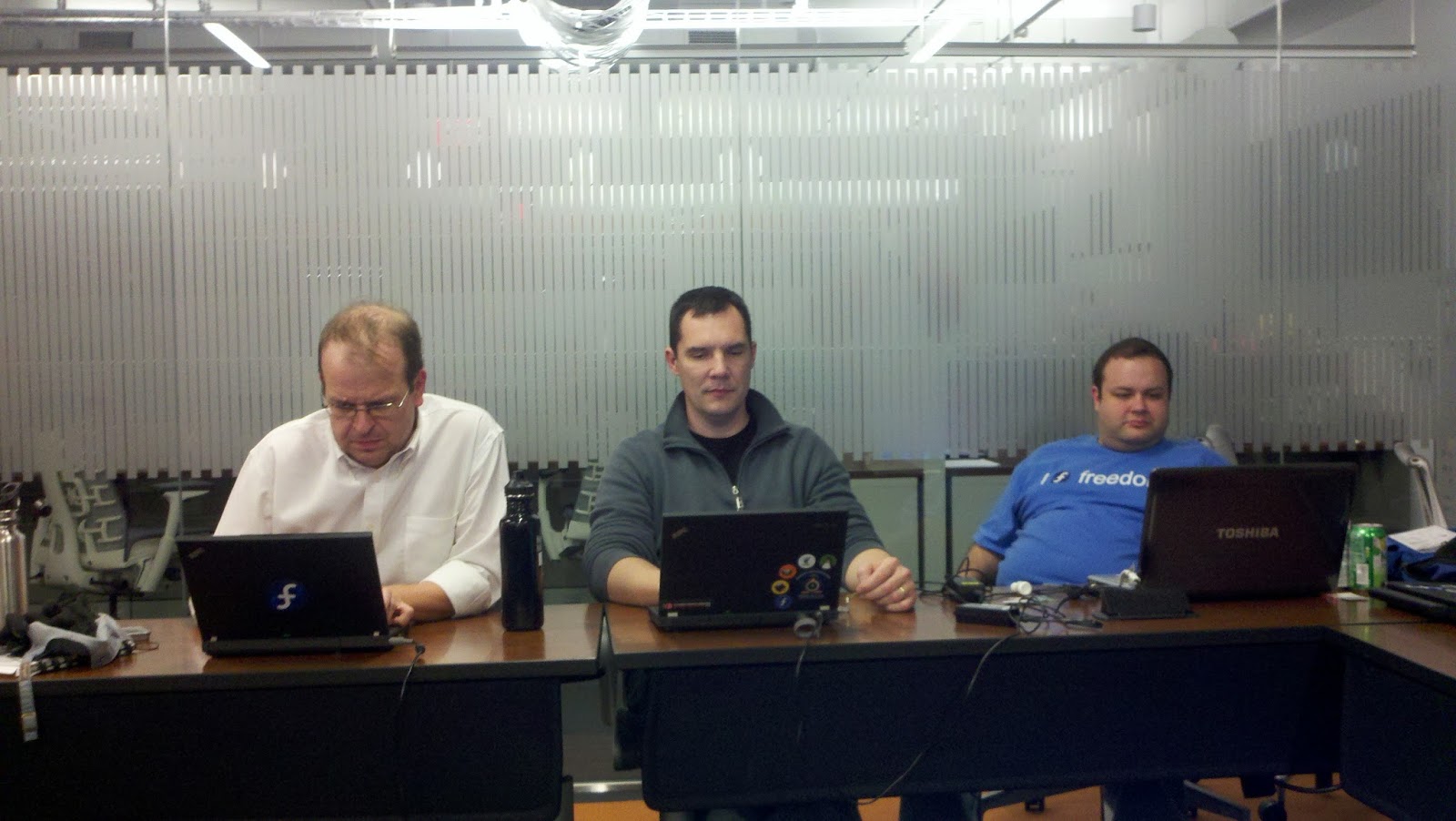
It is 11:30pm and hacking is still ongoing so I am going to finish this post with photos of people today:


** Yes it is a joke. No systemd or pulseaudio rpms were harmed in the pursuit of this debugging.